|
Webinar #73
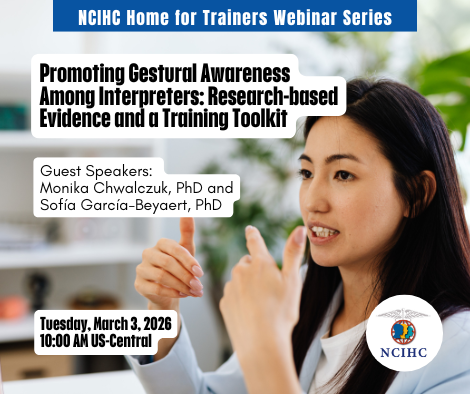
This 90-minute webinar took place on Tuesday, March 3, 2026
at 11:00 AM US-Eastern / 10:00 AM US-Central / 8:00 AM US-Pacific.
This webinar will be recorded. The recording will only be available through the NCIHC Learning Center. Once the recording is available, individuals will need to submit a separate registration form to view the recording, including those who registered for the live broadcast. Recordings are free for NCIHC members and $30 for non-members.
Registration is closed.

CEU Approvals
CCHI - 1.5 instructional hours
IMIA - 0.15 CEUs
RID - 0.15 CEUs
Promoting Gestural Awareness among Interpreters: Research-Based Evidence and a Training Toolkit
with Guest Speakers: Monika Chwalczuk, PhD, and Sofía García-Beyaert, PhD
This webinar starts with an overview of research insights from the field of gesture studies and how they apply to the context of healthcare interpreting. Concrete examples are used to illustrate the impact of gestures on the interpreter’s speech fluency and their cognitive processing, as well as the way interpreting service users perceive the performance of the interpreter based on body language. The videos for such examples come from authentic and simulated interpreting interactions recorded in the context of a funded research project. They provide examples that help discuss the key areas where gestural awareness is of particular importance.
For the second part, we turn our attention to training tools. We present and showcase a set of open-access materials that were designed to promote gestural awareness and help trainers teach about the impact of body language on the way an interpreted event unfolds. The body language of all participants is worth considering: the interpreter’s, the patient’s and the service provider’s. The goal is to offer trainees and practitioners with tools that allow them to develop an ever more concrete understanding of how to take in others’ gestures and how to manage one’s own. The toolkit includes a visual taxonomy (The Gestural Awareness Wheel), a collection of videos, and a set of teaching guides.
Learning Objectives:
-
Report on research showing that the interpreter’s gestural style has an impact on how their performance is perceived.
-
Cite research-based examples that illustrate the impact of gestures on the interpreter’s cognition and speech fluency.
-
Advise professional interpreters on how to consciously manage their gesture production during assignments.
-
Use the Gestural Awareness Wheel to generate constructive discussion during trainings with professional interpreters.
-
Name 3 concrete ways in which gestural awareness can have an impact on the ability of the interpreter to support communicative autonomy.
About the Speakers:
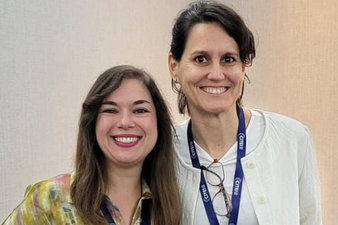
Dr. Monika Chwalczuk (left) and Sofía García-Beyaert, PhD (right)
Monika Chwalczuk, PhD
Dr. Monika Chwalczuk is a Lecturer in Interpreting and Translation Studies at the University of East Anglia (UK). She is a member of the British Academy Early Career Researcher Network and a former Marie Skłodowska-Curie Fellow. Monika received her PhD in Interpreting Studies from Université Paris Cité and completed her post-doctoral fellowship at the Polish Academy of Sciences.
She conducts research at the intersection of public service interpreting, gesture studies, and cognitive linguistics. Her interdisciplinary work combines multimodal corpus analysis, behavioural data, and self-reported measures collected in experimental settings, as well as psychophysiological indicators such as EEG and HRV.
Sofía García-Beyaert, PhD
Dr. García-Beyaert is an associate professor at the Universitat Autónoma de Barcelona, in Spain, where she researches and teaches interpreting. She is one of the authors “The Community Interpreter: an International Textbook”, through which she coined the concept of communicative autonomy. She is a member of the research group MIRAS and the principal investigator for the ongoing collaborative project “Situated Dialogues: Action-Research for Interactional Interpreting Training”. Her on-the-ground experience includes teaching and organizing continuing education courses for language access in the United States and conducting field work in Canada for her doctorate in public policy. Her research approach tends to blend the perspectives gained from both disciplines: interpreting studies and public policy analysis.

Access Statement: The goal of the NCIHC is to provide full access to anyone wanting to participate in our programming. We must receive your request for a reasonable accommodation no later than two weeks before the date of the event. For those who request accommodation after that date, every effort will be made to provide reasonable accommodation; however, we may not be able to do so given potential time constraints. If you need accommodations to participate, please email [email protected] by February 17, 2026.
You may download our updated Webinar Policies HERE
Return to the Trainers Webinars Page
|