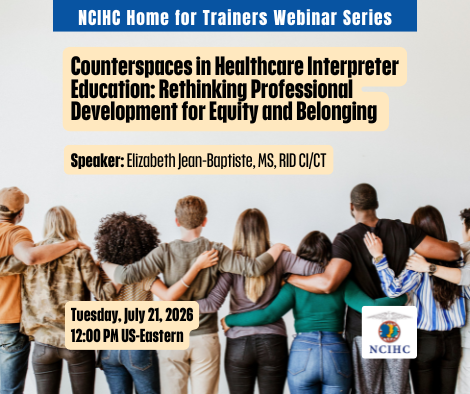
This 90-minute webinar will take place on Tuesday, July 21, 2026
at 12:00 noon US-Eastern / 11:00 AM US-Central / 9:00 AM US-Pacific.
This webinar will be recorded. The recording will only be available through the NCIHC Learning Center. Once the recording is available, individuals will need to submit a separate registration form to view the recording, including those who registered for the live broadcast. Recordings are free for NCIHC members and $30 for non-members.
Register Now!
Click on the button below to register for this live event.
You will be forwarded to Zoom for a second registration.
Your Zoom Webinar link will be sent to your email.
Webinar Cost:

CEU Approvals
CCHI - pending
IMIA - pending
RID - pending
Counterspaces in Healthcare Interpreter Education: Rethinking Professional Development for Equity and Belonging
Speaker: Elizabeth Jean-Baptiste, MS, RID CI/CT
Interpreters from minoritized identities continue to be underrepresented across the interpreting profession—including in healthcare, where these gaps can influence communication, trust, and patient care. This webinar shares insights from a dissertation study of a professional development training for healthcare interpreters, which was intentionally designed as a “counterspace”. Research defines counterspaces as supportive, identity‑affirming spaces that offer psychological safety and challenge norms through collective resistance and reflective practice.
The study, presented in this webinar, explored how interpreters experienced learning while in a counterspace. Participants described how the training offered a place of refuge where they could recover from the onslaught of daily oppression, build resistance practices, and develop resiliency.
For healthcare interpreter educators, this session highlights why identity‑centered professional development matters—and how it can strengthen confidence, community, and readiness for racial and cultural dynamics that frequently surface in interpreter education. The webinar also touches on what it means for non-minoritized interpreters to participate respectfully and responsibly in spaces designed for their colleagues who often feel isolated in the field.
Attendees will leave with a clearer understanding of how counterspaces function, why they are impactful, and how their principles can inform more equitable and culturally responsive training practices in healthcare interpreter education.
Learning Objectives:
-
Explain the concept of counterspaces and why they matter in interpreter education.
-
Analyze how counterspaces influence interpreter growth through psychological safety, belonging, resilience, and professional confidence, as compared to traditional professional development models.
-
Identify common instructional habits, norms, or structures that may unintentionally reinforce dominant cultural expectations and assess where existing PD offerings may fall short in supporting interpreters from minoritized identities.
-
Discuss counterspace‑informed strategies to the design and facilitation of professional development and the responsibilities of non‑minoritized educators to support interpreters.
-
Develop an action plan for implementing more equitable and culturally responsive PD in their own programs.
About the Panelist:

Elizabeth Jean-Baptiste is an Associate Professor at the University of Cincinnati, a RID-certified interpreter since 2001, and an educator since 2005. She holds degrees in Signed Language Interpreting and Adult Education from the University of Wisconsin–Milwaukee and will complete her PhD in Educational Studies with an emphasis in Action Research this fall. Her research examines the role of interpreter educators and institutional responsibility to diversify our profession through collective resistance and reflective practice.
 Access Statement: The goal of the NCIHC is to provide full access to anyone wanting to participate in our programming. We must receive your request for a reasonable accommodation no later than two weeks before the date of the event. For those who request accommodation after that date, every effort will be made to provide reasonable accommodation; however, we may not be able to do so given potential time constraints. If you need accommodations to participate, please email [email protected] by July 7, 2026.
You may download our updated Webinar Policies HERE
Return to the Trainers Webinars Page