|
Webinar 77
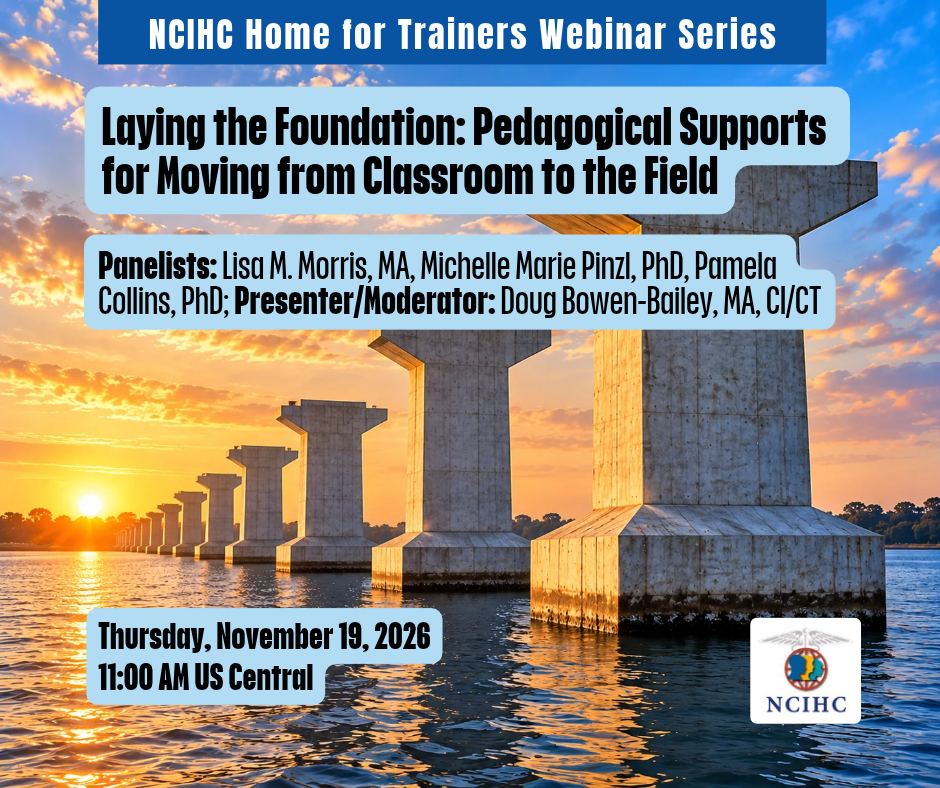
This 90-minute webinar will take place on Thursday, November 19, 2026
at 11:00 AM US-Eastern / 10:00 AM US-Central / 8:00 AM US-Pacific.
This webinar will be recorded. The recording will only be available through the NCIHC Learning Center. Once the recording is available, individuals will need to submit a separate registration form to view the recording, including those who registered for the live broadcast. Recordings are free for NCIHC members and $30 for non-members.
Register Now!
Click on the button below to register for this live event.
You will be forwarded to Zoom for a second registration.
Your Zoom Webinar link will be sent to your email.
Webinar Cost:
NCIHC Members: FREE

CEU Approvals
CCHI - pending
IMIA - pending
RID - pending
Laying the Foundation: Pedagogical Supports for Moving from Classroom to the Field
With Panelists: Lisa M. Morris, MA, Michelle Marie Pinzl, PhD, Pamela Collins, PhD; Presenter/Moderator: Doug Bowen-Bailey, MA, CI/CT
Interpreting is a profession that happens within and between communities. No matter the quality of instruction within a classroom, effective pedagogy needs to also include opportunities for student interpreters to engage with the communities they will encounter as professionals. This panel discussion focuses on the elements and approaches that can best prepare students for success as they venture into the field, including discussion of the experiential learning cycle, supervised interpreting & reflection, and communities of practice. In the first of a two-part series, come learn from the experience and insights of other educators who have laid the foundation for students’ professional pathways.
This is the first in a two-part webinar. The second part, slated for January 2027, will focus on the practical and logistical aspects of field-based practice.
Learning Objectives:
-
Describe at least two theoretical frameworks for building student capacity for reflective practice
-
List at least three approaches to providing field-based practice for student interpreters to connect with the communities they intend to serve.
-
Identify at least three educational objectives that can be used for field-based learning.
-
Articulate a rationale for the importance of a community connection for interpreter education programs.
About the Panelists:
Lisa M. Morris
Lisa Morris serves as the Director of Cross-Cultural Initiatives for forHealth Consulting at UMass Chan Medical School. She has dedicated her career to working in the field of medical interpreting as an interpreter, interpreter manager, and educator of interpreters and health care staff at several healthcare institutions and colleges in New England. She has worked on developing medical interpreter training and conferences, published, and presented on the topic of language access nationally. She has a degree in Romance Languages, a graduate degree in Training and Development, and completed a fellowship in Cultural Competence Leadership.
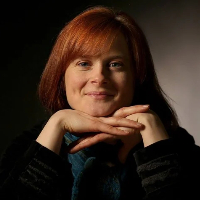
Michelle Pinzl
Michelle Pinzl (she/her/ella) is an Associate Professor at Viterbo University, where she directs the Community Interpreting Certificate program and teaches Spanish, French, and Interpreting Studies. She holds a PhD in Translation and Intercultural Communication from the Universitat Autònoma de Barcelona and an MA in Foreign Languages and Intercultural Management from the Université de Limoges. A certified Spanish <> English court and healthcare interpreter (CCHI), Michelle brings over 20 years of interpreting and training experience across healthcare, education, social services, and business in both rural and urban Wisconsin.
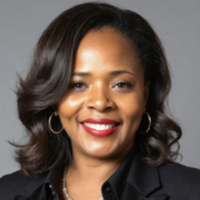
Pamela Collins
Dr. Pamela Collins, Associate Professor at Gallaudet University, joined the community in 2003, earning her BA, MA, and PhD before becoming faculty in 2017. A nationally certified interpreter, she brings a deep commitment to immersion, community accountability, and culturally grounded mentorship. Passionate about equipping future interpreters, Dr. Collins creates intentional spaces for student growth, guiding mentees beyond classroom boundaries to navigate real-world communities, cultures, and language practices. Her research and teaching focus on expanding access, equity for minority students, and advancing inclusive professional practice.
About the Presenter/Moderator:
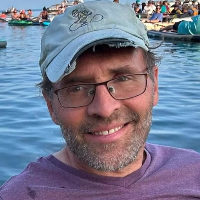
Doug Bowen-Bailey
Doug Bowen-Bailey is a Project Director and Instructional Designer for the CATIE Center at St. Catherine University, working on federal grant projects to support novice ASL-English interpreters as well as interpreters working in healthcare settings. He lives in Duluth, MN and has served as an interpreter in healthcare settings for over 30 years. He has a passion for leveraging technology for effective interpreter education while uplifting the human connection in the interpreting process.
 Access Statement: The goal of the NCIHC is to provide full access to anyone wanting to participate in our programming. We must receive your request for a reasonable accommodation no later than two weeks before the date of the event. For those who request accommodation after that date, every effort will be made to provide reasonable accommodation; however, we may not be able to do so given potential time constraints. If you need accommodations to participate, please email [email protected] by November 5, 2026.
You may download our updated Webinar Policies HERE
Return to the Trainers Webinars Page
|